
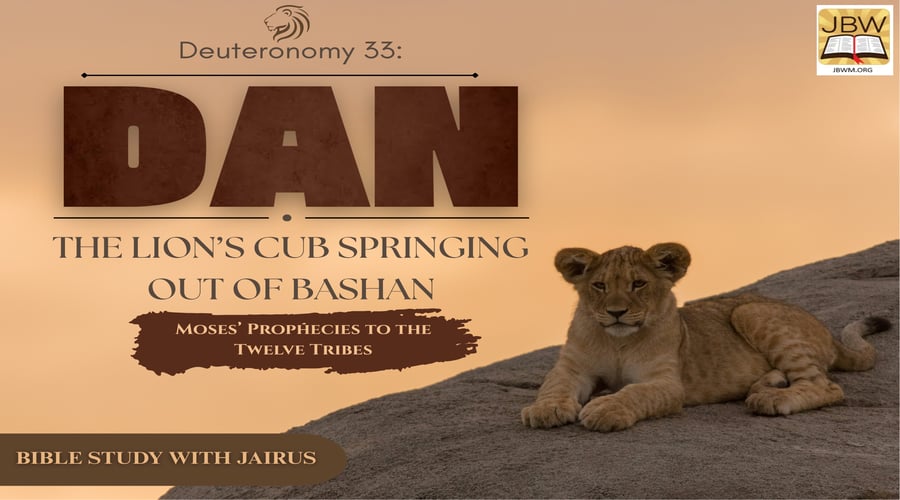
Deuteronomy 33: Moses’ Prophecies to the Twelve Tribes
Dan, the Lion’s Cub Springing Out of Bashan
Welcome and Opening Prayer
Welcome back to Bible study with Jairus. We continue our study of Deuteronomy 33, Moses’ prophecy concerning the tribe of Dan. We will look at Moses’ words alongside Jacob’s earlier prophecy about Dan, and consider what God’s salvation looked like in Dan’s story. I pray the Holy Spirit gives us understanding. Let’s start with prayer.
Dear Heavenly Father, we come to you humbly. We need your help. We need the Holy Spirit to bring us into the experience of Dan, into his prophecy, and to show us how sinners like Dan can receive your transformation and salvation, until we become a pearl gate in the New Jerusalem. We ask Jesus Christ to cleanse us with his precious blood. We ask the Holy Spirit to anoint us with oil. We ask the Heavenly Father to bless this hour. In the name of Jesus we pray, amen.
The Story of Rachel, Bilhah, and Dan’s Birth
According to Genesis 30, Leah had already given birth to four sons, Reuben, Simeon, Levi, and Judah, before her womb closed for a time. Rachel, meanwhile, could not conceive, and it grieved her deeply. She told Jacob, “Give me children, or I will die,” and Jacob grew angry with her, since the matter was not his to decide.
So, Rachel gave her servant Bilhah to Jacob as a wife, that she might bear children on Rachel’s behalf. When the first son was born, Rachel named him Dan, saying, “God has vindicated me; he has listened to my plea and given me a son.” Her humiliation, in other words, had been removed. Later Bilhah bore a second son, Naphtali, of whom we will speak another time. Rachel said of him, “I have had a great struggle with my sister, and I have won.”
The rivalry between Rachel and Leah, and the pain, neglect, and strife that surrounded it, formed the environment these children grew up in. It is worth pausing here, because our character is often woven together with our fate.
Character Shapes Fate
Why do we spend time examining the character of each of Jacob’s sons? Because God created each of us with a unique nature, yet how we respond to our environment, especially a difficult one, shapes who we become. Joseph is the clearest example. He suffered as much as any of his brothers, yet he understood his suffering completely differently than they understood theirs. He knew his brothers meant him harm, but that God meant it for good. He could see God’s purpose behind human sin and failure.
His brothers, especially Simeon, could not see past their immediate trials. They decided Joseph was the problem, and that killing him would solve it. God made us free agents with free will, and the way we interpret the world we are given, the lens we choose to look through, shapes our character and our future. Had Joseph not chosen to see God’s hand at work, he would surely have taken revenge on his brothers after their father died. He did not, because he understood that God’s will stood behind even the sinful behavior of the people around him.
Being born into a complicated, painful family often bends a person’s understanding of the world, sometimes into a mindset that Satan can use to build a stronghold within them. Hatred works that way. With that in mind, let me offer some imagination about why Reuben may have slept with Bilhah and defiled his father’s bed.
Imagining Dan’s Early Environment
Neglect and a kind of functional divorce can leave a wife bitter, but having children nearby often gives comfort. When I worked as a reporter in Los Angeles, there was a neighborhood we nicknamed “Second Wife Village.” Many corrupt officials from China bought expensive homes in America for their second or third wives, women who were, in effect, mistresses supported by stolen money. These men would visit occasionally, but their children largely grew up without a father’s presence. If you are aware of the Chinese community in Lost Angeles, you understand what I’m talking about.
Even so, many of these women managed to build a life around their children. A woman can often bear the absence of a husband if she has a child, sometimes more than one, to pour her love into. But take the child away from her, and that becomes far harder to bear.
With that in mind, consider Genesis 30 again. When Rachel proposed giving Bilhah to Jacob, she made the terms plain: Bilhah could bear the child, but the child would belong to Rachel, would sit on Rachel’s knee as her own. In effect, Rachel took Dan, and later Naphtali, away from Bilhah, since both boys were named by Rachel, not their birth mother.
I spent ten years without children before finally having what felt like a miracle child, and during that time I met many people connected to fertility clinics and heard many stories about surrogates. Sometimes a surrogate carries another couple’s child for nine months and grows attached, and separating from that baby is agonizing. Bilhah’s case was harder still. These were her own children by blood, yet by agreement they would never truly be hers.
If Bilhah had been allowed to raise her own two sons herself, she may well have had no need to seek comfort elsewhere. Instead, it is possible that grief, neglect, and unmet longing left her vulnerable, and that both she and Reuben were exploited by this vulnerability to defile Jacob’s bed. Many single mothers manage well when they can pour their love into their children. But take the children away, and the loss becomes unbearable. There are many single mothers in America that love and care for their kids. That, I believe, was Bilhah’s experience: two sons taken from her because, by agreement, they belonged to Rachel.
Growing Up Among Four Older Brothers
Seen this way, Dan was the firstborn son in Jacob’s household outside of Leah’s own children. I mentioned yesterday that Leah’s first four sons, Reuben, Simeon, Levi, and Judah, arrived almost as a single pride of young lions ready to conquer the world. I do not know exactly how Dan fit into that group, but I suspect it was not easy. Perhaps this offers some insight into how Dan grew up: how he responded to a difficult family situation, how his character was shaped, how he later fell, and how God eventually worked salvation through him, all of which Jacob seems to have observed and folded into his prophecy.
Character Traits and the Seed of Prophecy
The character traits Jacob observed in his sons became the seed of the prophetic blessings he gave them. Take Issachar, for example. Jacob saw in him the quiet patience of a donkey, and prophesied accordingly. Moses later built on that seed, blessing Issachar to rejoice in his tents alongside Zebulun, one carrying an apostolic calling and the other a prophetic one, together drawing Jew and Gentile alike to the mountain of God.
First Chronicles 12 even records that the men of Issachar understood the times and knew what Israel should do. You can see how a single observed trait develops, generation after generation, into a fuller calling. God spoke over Zebulun not only through Jacob’s blessing and Moses’ prophecy, but also through Isaiah in chapter 9, who foretold that Galilee, once a place of contempt, would become the very region from which the ministries of Jesus and Peter emerged. Contempt and humiliation, in other words, can become the starting point for God’s greatest work.
The same pattern of development shows up in Dan’s story. I have already offered a picture of the environment Dan may have grown up in, based on Genesis 30 and common human experience. Now let’s turn to Jacob’s prophecy itself, and ask the Holy Spirit for further light.
Jacob’s Prophecy: Dan Will Provide Justice (Genesis 49:16-17)
Jacob said, “Dan will provide justice for his people as one of the tribes of Israel. Dan will be a snake by the roadside, a viper along the path, that bites the horse’s heels so that its rider tumbles backward.” This is vivid, mysterious, prophetic language, and it deserves some unpacking.
Why would Jacob say Dan will provide justice for his people? I believe Jacob’s blessings, in every case, were rooted first in what he observed in his sons growing up within a large, complicated, and often painful family, itself a small picture of the wider human world: a field of sin, neglect, hatred, and misunderstanding. Yet without anyone fully seeing it, God was already preparing, out of this difficult and sinful family dynamic, a seed of salvation. Eventually a Savior would come from the tribe of Jacob to save the world, and all twelve tribes would one day experience God’s transforming power and become the pearl gates of the New Jerusalem.
I doubt anyone living in Old Testament times, or even most Jewish people today, holds this full revelation, that the twelve tribes will one day become the twelve pearl gates of New Jerusalem, gates through which both Jew and Gentile enter the mountain of God to worship him. Jacob may have grasped part of this. He was a prophetic man who had encountered God many times, through the suffering of his life, the tension of four wives, twelve sons, and one daughter, and the long process of maturing through pain. By the end of his life he could bless even Pharaoh, the greatest ruler of his day, and speak prophetic promises over his own sons. So in some measure, Jacob may have understood that humanity’s temporary suffering leads, in God’s hands, toward eternal salvation.
The Nature of True Justice
Justice is always tied to injustice; wherever there is a cry for justice, an injustice has already occurred. I imagine that as Leah’s four sons, Reuben, Simeon, Levi, and Judah, were growing up, they did not always act righteously toward their younger brothers. There may well have been bullying. And wherever injustice exists, a need for justice follows.
We see the same pattern in American history: real injustice was done to Native Americans, and African Americans. Nobody honestly denies this. But where do we find true justice? Consider a case that made headlines: an African American man was reported to have said, after killing a white woman from Ukraine, that he had “killed another white girl.” That is not justice. That is injustice compounding injustice. True justice is never found simply in harming the person, or the group, that once caused harm. Even given a long history of injustice done to African Americans, killing a woman simply because she is white, without even knowing her nationality or her story, is not justice. It is revenge.
Here is the key distinction: injustice creates a genuine need for justice, but true justice never comes from revenge or hatred. It comes only from the righteous judgment of Jesus Christ and God our creator.
Given this pattern, it seems likely that Dan grew up experiencing real injustice himself. Perhaps he was taken from his mother, Bilhah, as I described earlier. Perhaps he was mistreated by his older brothers. Out of that kind of wound, a person typically responds in one of two ways: by seeking revenge, which seems to have been Simeon’s path, or by becoming someone God uses, imperfectly, as an instrument of justice on behalf of others, as we later see in Dan’s descendant Samson.
Dan Among the Twelve Tribes
Jacob continues by naming Dan as one of the tribes of Israel, which carries its own quiet mystery (Genesis 49:16). In Revelation, among the 144,000 sealed from the twelve tribes, Dan is notably absent. Many scholars believe Dan was cut off from that number. And yet in the end, Dan still appears among the pearl gates of the New Jerusalem. Somehow, mysteriously, Dan is preserved even after apparently being cut off. What happened to Dan in childhood, and what he had to pass through afterward, both seem bound up with this eventual salvation, brought about through Jacob’s prayer over him and, no doubt, others.
The Viper by the Road (Genesis 49:17)
Jacob’s language here is a prophetic picture: Dan as a snake by the roadside, a viper along the path, striking at the horse’s heels so its rider falls backward. Picture Dan struggling against his four older brothers, perhaps riding ahead on horseback while Dan, smaller and pushed to the margins, waited by the road like a snake, ready to trip them up. Perhaps his brothers once chased him on horseback, only to be outwitted by him in the end. Whatever the precise memory behind the image, it likely reflects how Jacob observed Dan dealing with his brothers inside that difficult family.
Dan’s Later History: The Danites and the Idols of Micah
History bears this pattern out. Dan’s tribe would later lose the land originally allotted to them, wander in search of new territory, and, according to the book of Judges, forcibly take a priest and idols from Micah’s household, killing many people along the way. The tribe of Dan gained a reputation for ferocity. When Micah’s household pursued them to recover what had been stolen, Dan’s answer was blunt: we are fierce people, we show no mercy, do not push us further or we may kill you and no one will ever know.
That same characteristic, biting like a viper, seems to have been present even in Dan’s early dealings with his own brothers, and it eventually spread into open harm against his own kinsmen, God’s own people. Dan’s tribe did not simply lose their land. They also became, in the north, a leading center of idol worship, home to one of the golden calves that drew Israelites from as far away as Dan itself to bow before an image instead of God. Given the whole of this story, it becomes clear that Dan experienced, and caused, a great fall. That is precisely the condition that calls for salvation.
From Injustice to True Justice: The Cross
After describing Dan’s character and his calling to bring justice for God’s people, not through revenge or hatred toward his own brothers, Jacob’s prophecy touches something universal. Whether we are white, black, Asian, or any other background, we are all part of one humanity, all made in the image of God. Our real fight is not against flesh and blood but against the ruling authorities of darkness, as Paul writes. Yet however we were raised, and whatever injustice we may have suffered, whether as an African American in America today or as Dan among his brothers, the first instinct, born of human failure, limited understanding, and a poor grasp of God’s wisdom in suffering, is to answer injustice with more injustice: to seek revenge. I believe that was Dan’s temptation as well. In a sense, his prophetic calling, to bring justice for God’s people as one of Israel’s tribes, was meant to redirect that very impulse.
I am an immigrant, and as an Asian and Chinese American I have experienced discrimination too. But the way we pursue God’s justice cannot be by creating fleshly injustice against those who wronged us. Every sinner starts out this way, believing the sword is the answer. That is why Peter drew his sword, and why Jesus told him to put it away: those who live by the sword die by the sword. True justice comes only through the justice of God, made visible when Jesus Christ was put to death on the cross. There, the justice of God was fully satisfied, and because of it, our sins can be forgiven. The deepest injustice ever committed against a human being, what was done to Jesus Christ, became the very means by which God’s justice and our reconciliation were accomplished. He bore all our sin and injustice. Apart from that, God could not reconcile with us, because the wages of sin is death. But Christ accomplished our redemption and became, in himself, the righteousness and justice of God.
So, the calling on Dan, to bring justice to God’s people, was never a calling to create more injustice. Yet that is exactly the mistake Dan seems to have made. Even Moses, called to lead Israel out of Egypt, could not do so by killing an Egyptian, and when he tried, his own people rejected him, saying, “Do you mean to kill me as you killed the Egyptian?” The injustice done to us can only be redeemed through the justice of God found in Christ. That is a hard lesson to learn.
Jacob’s Cry for Salvation (Genesis 49:18)
This realization seems to be what brings about the one truly unique moment in this part of Jacob’s prophecy. Unlike his words over any other son, Jacob suddenly cries out: “Lord, I long for your salvation. I look for your deliverance.” I do not know whether Jacob glimpsed the person of Jesus Christ before his incarnation, though Jesus himself said that Abraham rejoiced to see his day, and Paul writes that the spiritual Rock, who is Christ, accompanied Israel through the wilderness. Whether or not Jacob saw Christ directly, in this moment he clearly acknowledged, through all the suffering, sin, strife, and hatred surrounding him, and through humanity’s habit of answering injustice with more injustice, that he needed a Savior.
This is really the trajectory of the entire Old Testament. The law and the prophets, Paul tells us, find their conclusion in Christ. Long before that fulfillment came, people sensed it and cried out from the heart, “Lord, I need your deliverance.” That itself is a prophetic declaration, a foreshadowing of the dead being called to minister justice. We are all, in that sense, dead in our need, and yet Paul reminds us that one day we will judge angels. Our true enemy was never each other, not black against white, not Jew against Gentile, not Joseph against his brothers, but the fallen spiritual powers who deceived Adam and have deceived humanity ever since. When we finally grasp that we are the body of Christ, many sons among many sons, we will enter into the glory that will be revealed when Christ himself is revealed, and all creation, groaning under corruption, will finally be set free, as Paul describes in Romans 8.
Every person eventually reaches a point, as Paul confesses in Romans 7, where they say, “I am a wretched man; I need a Savior.” Dan’s experience, his calling to minister justice, and his tendency to pursue it through more injustice, were all seen by his father Jacob, who prophesied that Dan, above all, needed deliverance. That impulse toward revenge was never going to accomplish what God intended.
Moses’ Prophecy: The Lion’s Cub from Bashan (Deuteronomy 33:22)
This brings us to Moses’ own prophecy, given here in a single striking sentence: “Dan is a lion’s cub, springing out of Bashan.” Bashan was ruled by King Og, a place associated with a demonized people, made in God’s image yet given over as tools of evil, who refused every chance to repent. God eventually used Israel to bring judgment on them and establish justice in that land, since they had rebelled against him and allied themselves with evil.
Yet out of that very place, Bashan, Moses prophesies that Dan will spring forth like a lion’s cub: a picture of the mature body of Christ, of the many sons of God coming into the fullness of their calling, victorious and reigning as co-heirs with Christ. This lion’s cub is a young king, destined to represent the body of Christ in judging the fallen powers. Bashan itself stands as a picture of a fallen earth full of fallen people, over whom God nonetheless brings justice through his own people, just as the Canaanites represented the wider world of demonic influence that God will ultimately judge through his church, the victorious overcomers who carry his justice into an unjust world.
That is the meaning of the lion’s cub springing out of Bashan. It tells us that Dan, though seemingly cut off, will be restored among the tribes of Israel and stand as one of the pearl gates of the New Jerusalem, bringing justice at last to an unjust world.
Closing Thoughts
Today, we as the church, as God’s people, are called to carry that same justice into our own unjust world. But the way we carry it is never through revenge or through inflicting fleshly injustice on those who have wronged us. It is through becoming, like Dan, a lion’s cub springing out of Bashan: co-heirs with Christ who will one day represent God, as many mature sons, in judging the fallen powers, even as we ourselves are brought into his eternal kingdom and glory.
I hope this gives you a little more insight into this prophetic picture. I will see you next time. Thank you for joining us.
Recent Comments